Indoor Air Quality: The Silent Productivity Killer In The UK
31/03/2026 by
admin
Do you know that stale office air might be the real cause of the 3 PM slump?
That quiet office afternoon, the screens are still glowing, and the workday is far from over. Yet the concentration of your workers starts to drift, someone reaches for another coffee, a few stretch in their chairs, while others stare blankly at spreadsheets before their minds catch up.
Most times, it is mistaken as fatigue or the natural rhythm of a long day, but facility experts are pointing to something far less obvious.
The air inside the office itself.
A research study by Kimberly-Clark Professional found that poor indoor air quality is responsible for a 5% to 15% reduction in workers’ performance. Guidance from organisations such as the World Health Organization (WHO), the UK Health Security Agency (UKHSA), and the Chartered Institution of Building Services Engineers (CIBSE) also asserts that Indoor Air Quality (IAQ) is a critical factor affecting work health, comfort, and productivity.
They highlight that poor ventilation, high CO2 levels, or high temperatures are strongly associated with Reduced Productivity (RP), increased absenteeism, and symptoms of Sick Building Syndrome (SBS) such as headaches and fatigue.
Across the UK, offices spend months sealed up during winter with the heating systems recirculating the same air. Moisture, dust, allergens, and microscopic pollutants build up quietly over time, and by the time spring arrives, many offices will be operating in environments where the air itself works against staff well-being and productivity. This is why indoor air quality in the office has become a growing concern among health professionals, workplace researchers, and facilities managers.
As a facility manager preparing the buildings for the new financial year, improving indoor air quality in the office goes beyond cleanliness to support staff well-being, concentration, and operational efficiency.
Why Office Air Becomes Stale After Winter
To understand the importance of improving indoor air quality, it helps to first understand why office air becomes stale during winter in the first place.
In the UK, buildings are extensively designed and regulated to conserve heat during colder months. While that improves energy efficiency, it also reduces ventilation.
Over time, several things begin to happen inside the building:
- Dust accumulates in carpets, upholstery, and ventilation systems.
- Allergens such as pollen, dust mites, and mould settle indoors
- Carbon dioxide levels increase due to poor airflow
- While traditional cleaning methods redistribute particles into the air.
All these, when accumulated, create “stale air syndrome”. Employees may not notice it, yet the effects show up in subtle ways like the 3 PM Slump.
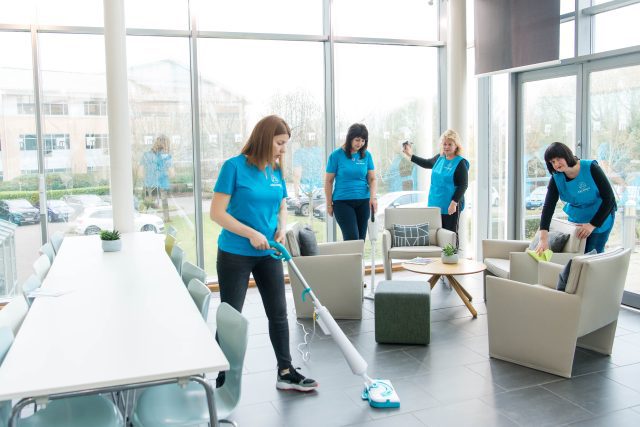
The Archway Facilities team implements a multi-layered cleaning strategy, using HEPA-filtration and steam technology to remove allergens and pollutants, significantly boosting indoor air quality in UK workspaces.
The Archway Facilities team implements a multi-layered cleaning strategy, using HEPA-filtration and steam technology to remove allergens and pollutants, significantly boosting indoor air quality in UK workspaces.
For organisations preparing for the financial year operations, addressing this issue is no longer optional. It is part of building a high-performing workplace.
Archway Facilities approaches this seasonal challenge by treating air restoration as part of the spring facility reset, ensuring your offices in the UK enter the new financial year with healthier indoor environments.
Technical Solution for Improving the IAQ Office in 2026 (HEPA)
Not all cleaning systems improve the indoor air quality in the office; this is where High Efficiency Particulate Air (HEPA) Filtration becomes essential.
The HEPA-grade system can trap 99.97% of airborne particles as small as 0.3 microns, such as dust and micro dust particles, pollen, mould spores, and allergens caked in carpets and upholstery. Hence, it is increasingly required for professional cleaning providers to incorporate HEPA-grade systems to meet the IAQ office 2026 standard.
Archway Facilities integrates HEPA filtration into its commercial vacuum system and air scrubbers to ensure the cleaning process actively removes dust particles and contaminants rather than distributing them. The difference is subtle yet powerful, and it captures the allergens and air pollutants permanently.
Benefits of an Improved Indoor Air Quality Office in 2026
Facility restoration after winter is often evaluated by cost; however, an improved IAQ in the office would boost cognitive performance by 61%, thereby increasing operational returns far above your investment.
Research has shown that improving the indoor air quality in the office can increase productivity by 5%. This number may appear modest, but paint this picture: A team of 50 employees working more efficiently for an entire year, reducing minor sick days linked to respiratory irritation, and staff well-being improves due to fresher and healthier air, giving you thousands of additional productive hours as deadlines are met and morale improves.

As UK businesses move toward holistic facility management, monitoring Indoor Air Quality (IAQ) and implementing high-efficiency air filtration has become as essential as surface cleaning for employee wellbeing.
In the above scenario, improving indoor air quality in the office is less about cost and more about protecting your employees and the organisation’s performance.
Archway Facilities offers advanced indoor air quality cleaning solutions that enable you to invest in your office environment and increase your staff productivity.
Flexible Cleaning Schedule: Nighttime Air Purification
We understand the busy commercial and corporate environment, and we believe that restoring your office’s indoor air quality should not disrupt your daily work activities.
At Archway, we address this by offering nighttime cleaning and air purification services. This way, HEPA vacuuming can be conducted without interrupting office activities, air scrubbers can run longer overnight cycles, and dust and allergens are removed before staff arrive in the morning.
Our flexibility allows organisations to improve IAQ office 2026 standards while enjoying uninterrupted daily operations.
Meeting WELL Building Air Standards For 2026 In The UK
Workplace well-being has become a defining priority for organisations. In the past, the workplace wellness initiative focused heavily on employees’ benefits (specifically health insurance) and mental health, rather than indoor air quality. However, the physical environment remains a critical factor.
The increasing global building and health standards emphasis the air quality as a critical component of healthy workplaces, which was a primary driver behind the creation of the WELL Building Standard developed by Delos and launched by the International WELL Building Institute (IWBI) in 2014.
Ever since, the WELL Building Standards in the UK have become a strict, performance-based air-quality standard that ensures high-quality indoor environments, with its main focus on reducing pollutants like VOCs, ozone, and particulate matter.

Rigorous surface sanitisation is a cornerstone of maintaining high indoor air quality (IAQ) and reducing airborne particulates in UK office environments.
Rigorous surface sanitisation is a cornerstone of maintaining high indoor air quality (IAQ) and reducing airborne particulates in UK office environments.
As you move towards restoring your facilities this spring, you should also ensure you comply with the IAQ office standards, which include performing air testing to verify pollutant levels are below specific thresholds, ensuring proper airflow and ventilation rates to manage CO2, and initiating plans to minimise pollutants.
Archway aligns its services with these evolving compliance requirements, helping offices to maintain buildings that meet the health and environmental standards.
Breathe Easier With Archway’s Invisible Clean
The biggest threats to workplace productivity are not always visible, like the dust, allergens, and stale air that quietly affect productivity level without drawing attention to themselves.
Improving IAQ in the office in 2026, aside from allowing you to meet up with the WELL Building Standards, is one of the most effective ways to improve your office productivity.
Through HEPA-grade filtration, advanced cleaning techniques, flexible nighttime purification, and aligning with modern air quality standards, Archway Facilities delivers an invisible clean, one that employees would feel immediately when they step into the office, even though they cannot see it.